Le Mans 2014

Although I didn’t post anything here I did do some Le Mans preview posts for Sidepodcast:

Le Mans Recharged – I did a bit of reading around to explain about the new rules and very different hybrid systems in the top LMP1 class.

Floating Points – the World Endurance Championship points situation before the race.

There is also a live thread here.

It has been a good race so far, lots of incidents and great racing. Let’s hope the rest of the race is just as good!

A Preview of the Le Mans 24 Hours 2012

I have written a preview of this year’s Le Mans 24 Hours in which I spend a couple or three paragraphs on each of the four classes, plus the LMP1 non-manfacturers and the Delta Wing. I’ve also included a selection of useful links.

You can find the preview at Sidepodcast.com as part of their build up to live commenting the race. They’ve done a great job adding some nice photos to the post.

I’ll also be tweeting copiously throughout the race weekend, I offer apologies now as sometimes I get carried away with it. I’ve been putting together a Twitter list for sportscar racing including many of the people at Le Mans this weekend, feel free to follow it if you think you’ll find it useful.

2012 FIA WEC Preview

This year’s endurance racing calendar is something special, for the first time in 20 years we have a world championship for long-distance sportscar racing and it promises to develop into something big over the coming years.

It is a shame that one of the main instigators of the FIA World Endurance Championship, Peugeot, was forced to withdraw before the season. Audi vs Peugeot would’ve been even more fraught than we’ve seen in the past with a world title on the line! Toyota had already planned to join midseason. They, the FIA and the ACO should be applauded for working to have then enter more races than was originally planned and for adjusting the points system to allow dropped scores, so the LMP1 championship is mathematically still on the line even if Audi will surely win it comfortably.

Calendar

The centrepiece is of course Le Mans, with a calendar featuring some of the best events of the international endurance racing calendar of the past few years, added to new events in Brazil, Japan and controversially, Bahrain.

A curious and notable absence is Petit Le Mans which will revert to being ALMS-only this year, not a popular decision and even worse when Bahrain was originally scheduled for the same weekend. That madness has been avoided but PLM still falls between two Asian WEC events on weekends either side of it, so it’ll be very difficult indeed for any WEC teams to compete in Georgia.

March 17th – 12 Hours of Sebring (with ALMS)
May 5th – 6 Hours of Spa-Francorchamps
June 3rd – Le Mans Test Day
June 16th – 24 Hours of Le Mans (with other invitiationals)
August 26th – 6 Hours of Silverstone
September 16th – 6 Hours of Sao Paulo
September 30th – 6 Hours of Bahrain
October 14th – 6 Hours of Fuji
Novmeber 11th – 6 Hours of Shanghai

Prototypes

In LMP1, the fight between the HPD teams Strakka, JRM and at Sebring, Muscle Milk should be tight and they’ll be up against the Lolas of Rebellion, and OAK and Pescarolo with their eponymous chassis. Throw in a mix of engines from HPD (Honda) to Toyota to Judd and at Sebring a Mazda as well. All the runners are on Michelins except for the Dunlops on the OAK and Dyson cars. Familiar names include Brabham, Prost, Chandhok, Heidfeld, Bleekemolen, Watts, Kane, Collard and Boullion.

LMP1 isn’t the only interest, there is a strong field in the petrol half of LMP1, and in LMP2 and the two GTE categories. At Sebring we have the added excitement of the ALMS contenders joining the fun, and at Le Mans we’ll see some of the best teams from the ALMS and ELMS join the WEC for the classic 24 Hours. Also at Le Mans we will see the race debut of the Delta Wing which promises to be very exciting – I hope it is reliable!

LMP2 is worth watching for once. No longer is it a collection of underfunded teams with cars which break down easily. There are solid entries from Signatech, OAK (again), Greaves, PeCom and even the GrandAm team Starworks are entering the WEC. Cars range from Lolas to Orecas to Zyteks to HPDs to Morgans (rebadged OAK) and engines from Nissan, Judd, HPD and Lotus. All cars are on Dunlops. The drivers may be less familiar but Starworks signed a coup with Stephane Sarrazin for the longer races.

GT

GTE Pro features Fisichella and Bruni with AF Corse, in their other car Olivier Beretta switches from Corvette. They’re up against the similar car of Luxury Racing with Vernay, Melo and Makowiecki. Aston Martin rejoin the field after their LMP stints and they have Mucke, Turner and Fernandez. Felbermayr’s line-up of Lieb and Lietz is not to be doubted either. At Sebring of course they are joined by the very strong ALMS teams of Corvette, BMW and various Porsche teams.

GTE Am is for year-old cars and they must run at least one (or two?) amateur drivers. Larbre Competition have a couple of Corvettes and Pedro Lamy, AF Corse and Luxury also entered Ferraris here (including one for Michael Waltrip at least for Sebring), Felbermayr have another Porsche and don’t count out Krohn’s green Ferrari.

Others

There are 35 cars signed up for the full season. These will be joined by ‘wild card’ entries through the year, though we don’t know the details yet.

At Sebring we add in the Prototype and GT Challenge classes for spec Orecas and Porsches respectively. 64 cars at Sebring, and 56 at Le Mans including the Delta Wing.

Even if Audi does win it all, the other classes should be interesting. Perhaps more interesting is this is the first ‘building’ year of the series, taking a step up from last year’s ILMC. After showing what it can do this year, who else might enter in 2013 and 2014? There are exciting years ahead!

Trop de Course?

This guest post appears as part of the latest round of the VivaF1 Blog Swap, and is written by Maverick from the host site itself.

One group who currently seem to have no fear of being snowed under with Too Much Racing seems to be the French, with no sign of the return of the French Grand Prix and the motorsport industry in general, in the doldrums. That said, you could be forgiven for thinking that as long as they have 24 Heures du Mans, they’ll remain happy.

Often considered the original Grand Prix, having first run in 1906, the French Grand Prix (or Grand Prix de l’ACF as it was) missed just one season of the Formula World Championship in 1955. That was, until 2009 when the race was cancelled with organisers citing economic reasons. Since that announcement at the end of the 2008 season, the French Grand Prix has shown little sign of returning regardless of the number of proposed locations, most notably at Flins-Les Mureaux where plans for a new circuit were eventually abandoned. Despite Magny-Cours recently expressing confidence that a series of improvements would see the race return in 2012, the already crowed calendar would seem to prevent that prospect for the foreseeable future. Meanwhile, the longer the race remains absent from the Formula One calendar, the less it can rely on playing the “historic race” card.

It’s not only France’s international status that has fallen in to decline. In 2003 the French Formula Three series merged with its German counterpart to form the Formula Three Euroseries as entries dwindled. While the Signature and ART Grand Prix teams have produced a strong French showing in the series, its notable that the French only host a small proportion of the series and just one of this year’s nine meetings took place on French soil.

So Le Mans remains strong but the Grand Prix has gone, meanwhile the third part of French motor racing’s triumvirate, the Pau Grand Prix has become a shadow of its former self. The Pau Grand Prix, the first race to carry the title “Grand Prix” back 1901 was for a period a non-championship F1 race before becoming the jewel in the crown of Formula 2 and then F3000. However, it has gradually lost its lustre in recent years before being suspended altogether this year. It remains to be seen whether the ambitious invitational event for F3 cars planned next year can revive this grand old lady of motorsport.

It’s not only the motor racing though but the whole associated industry that appears to be in the doldrums.

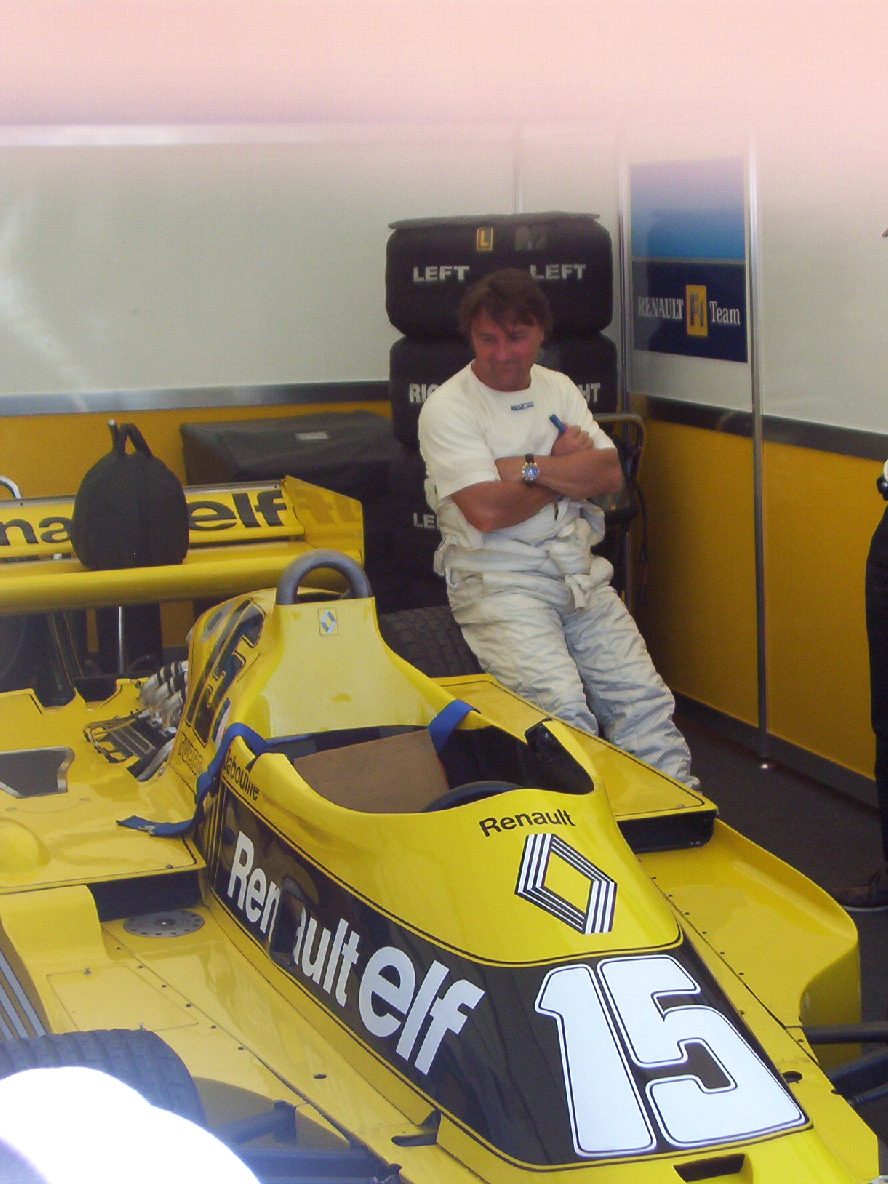
French motorsport as a whole may end up as wistful as Rene Arnoux at the 2003 Goodwood FoS

While there are sparks of optimism, notably Peugeot’s Le Mans exploits while ART Grand Prix has been a force to be reckoned with in GP2 and F3, the inflexible labour market has prevented teams from being competitive with outfits from other countries. If you consider that Renault F1 is fundamentally an English team funded by the French (and now only partly so) then the last French Formula One team was Prost Grand Prix which folded at the beginning of 2002 with debts in the region of $30 million. Prior to that, AGS and Larrouse suffered similar fates while the DAMS F1 project got little further than building a chassis.

The result of that has inevitably filtered down the feeding chain in the form of a lack of support for up and coming, home-grown talent. In recent years, Romain Grosjean, Sébastien Bourdais and Franck Montagny have quickly come and gone and the last French drivers to make a substantial run in F1 were Olivier Panis and Jean Alesi whose careers came to an end in 2004 and 2001 respectively. Perhaps, the few prospects for the future are this year’s British Formula Three Champion, Jean-Eric Vergne, who tested with Toro Rosso in the recent young drivers’ test, and Ferrari test driver Jules Bianchi. However, a few years ago the same would have been said about Grosjean. Unfortunately, the question is whether any of them can secure the necessary financial backing to fund their way to the top echelon of open-wheel racing in a climate of French motor sport apathy.

Still, Le Mans carries on shouldering a nation’s motoring pride (alas, Peugeot’s self destruction spoilt the party this year) and while the French Grand Prix’s absence continues, that reliance will only strengthen in the hearts and minds of the French.

Overall, it’s a sad state of affairs that the country that gave motorsport to the world finds itself in. The French created the Grand Prix and for the early decades of racing their blue cars dominated. Yet that appears to be part of the problem: A look at the racing calendar of French circuits sees classic car races predominant. In short, French motorsport gives the appearance of being content to dwell on the glories of the past with no plan for the future.